• german
  • english
  • Français
  • Italian
 
english
Samstag, 18 Mai 2013

The Lutheran Church St. Anna Augsburg

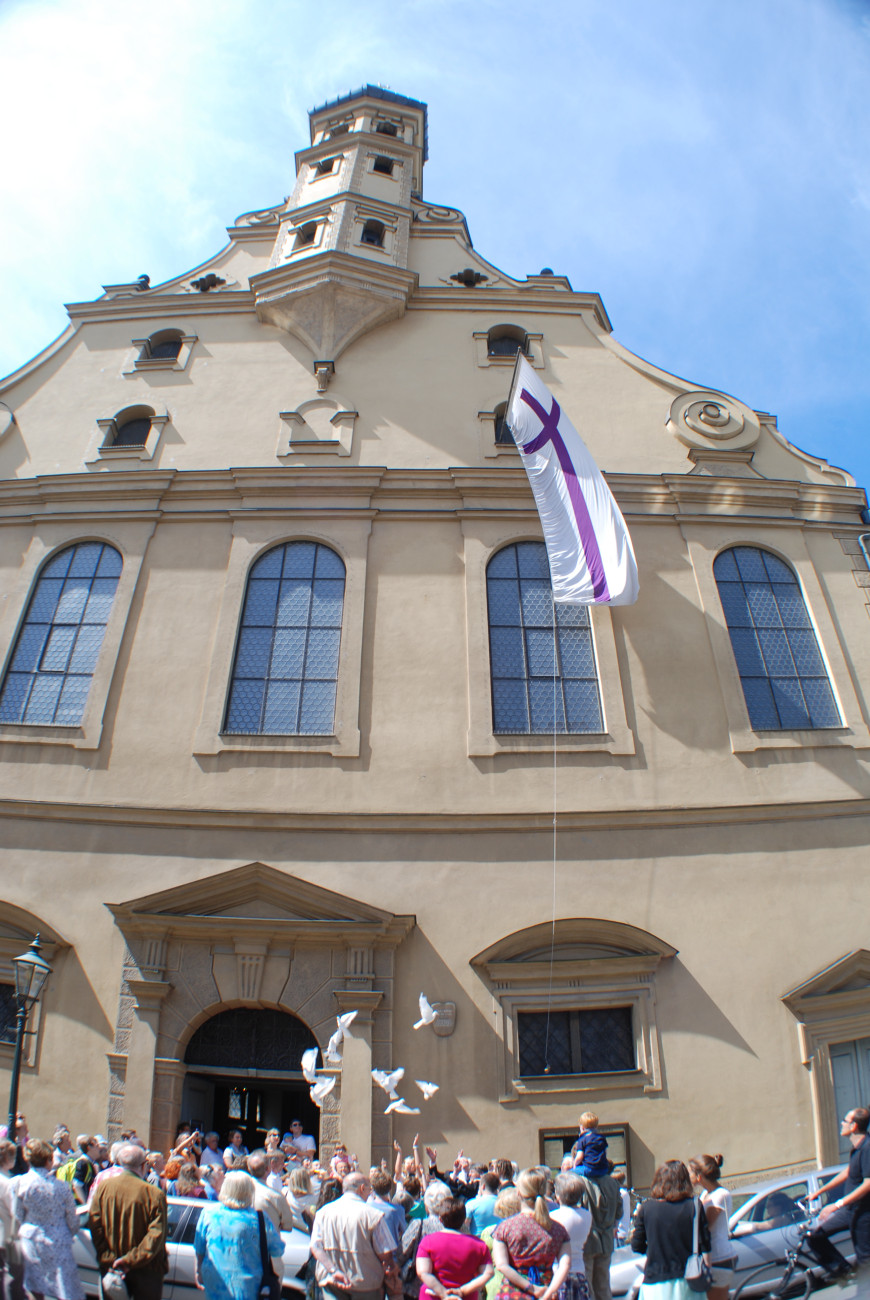
The St. Anna complex

The St. Anna complex was originally built as a Carmelite monastery. The first church was erected in 1321, but from that epoch only the “Large Sacristy” is still existent.

The Goldsmith's Chapel

In 1420 the Goldsmith's Chapel (Goldschmiedekapelle) was donated as a pilgrim chapel by Conrad Hirn and his wife Afra. Hence the frescos in the choir show the great pilgrim fathers. The goldsmiths, custodians of the chapel, enlarged it in 1496 and used it as their burial place.

The frescos on the walls are outstanding examples of the change from mysticism to realism in the 15th century.

Right: Herod orders the high priests and scribes to locate the birthplace of Christ.
Nearby: the meeting place of the Magi. Then follows Christ’s passion from the Last Supper to the Crucifixion.
Left: the legend of Helene dispatching the pilgrim fathers in search of Christ’s cross.
Christopher; St. Georg’s fight with the dragon.

1487-1497 the Church was enlarged to its present size - excluding the Fugger-Chapel.

Thus in about 1500 the monastry consisted of a pillared basilica with the east choir, the large sacristy, the goldsmith’s chapel, the cloister, the cells and the courtyard, called the "Lutherhöfle" (Luther’s little coutryard).

Martin Luther

When Martin Luther was summoned to defend his teaching before the papal legate Cardinal Cajetan he stayed in the monastery from 7 - 20 October 1518, as a guest of Prior Frosch. Luther met Cajetan in the Fugger’s house and all that was required was for Luther to recant. But he refused and fled the town.

The Fugger Chapel

The Fugger Chapel (1509 - 1512) was founded by Jakob Fugger and his brothers Ulrich and Georg as a burial chapel for the male members of their families. It represents the first d decisive achievement in ecclestiastical building in the Renaissance style in Germany. Apart from the organ builder J. Dobrau no master builder can be identified with cdertainty. The prevailing opinion is that the designer was Albrecht Dürer, Hans Daucher sculptured the six putti on the balustrade, the wonderful marble floor with the coat of arms of the Fugger family ( a blus and yellow lily) and their trade mark ( a spindle) was inlaid by Adolf Daucher, a carpenter. The four epitaphs on the back wall are for Jakob Fugger and his brothers. The designs of the two middle epitaphs (Ulrich, Georg) come from Albrecht Dürer depicting the Resurrection and the battle of Samson with the Philistines. In the outer epitaphs for Jakob Fugger, warriors in ancient uniforms bear the Fugger coat of arms. Dominating the upper part of the chapel is the organ, totally destroyed in 1944, rebuild in 1978. The organ wings had been removed, so we see the original paintings by Jörg Breu the Elder. The large wings show Chrits’s Ascension and the Assumption of the Virgin Mary, the little ones “the invention of music” The altar ist a masterpiece by Hans Daucher. The three predella reliefs depict Christ carrying the Cross, Christ being taken from the cross, his descent into Hell. In the altar group the body of Christ, supported by an angel, his mother and St. John is presented for mourning. In front of the altar a marble slab covers the steps to the crypt.

Chapel of the Holy Sepulchre

To the left of the Fugger Chapel is the Chapel of the Holy Sepulchre, an imitation of that in Jerusalem. Built in 1506 and purchased in 1656 by the Österreicher family, it is also called “Österreicher Chapel”.

Gustv Adolphus King of Sweden

According to the Restitution Edict of 1629 the Chruch of St. Anna was barred to the Protestants. When Gustv Adolphus King of Sweden entered Augsburg in 1632, he ordered his court chaplain Fabricius to hold a thanksgiving service at St. Anna. In 1635 the Lutherans were again locked out. For 14 long years they had to worship in the open air in the courtyard of St. Anna College and it was only in 1649 that the Protestants got back their church. Thus after the 30 Years War extensive renovations were necessary. In 1682 the chandelier and the carved wooden pulpit - and two years later the gallery - were added..  Since 1747 the ceiling has been vaulted and decorated in the baroque and rococo styles. The three large frescos painted by Johann Georg Bergmüller show the Sermon on the Mount ( Jesus the Prophet) the Crucifixion (Jesus the priest) and Judgement Day (Jesus the King). The stuccowork was carried out by Simpert Feuchtmaier from Wessobrunn.

Principal paintings of interest in the east choir:

  • Lukas Cranach the Elder 1529: portraits of Martin Luther and of Johann friedrich Electoral Prince of Saxony; Christ blessing the children( predella of the altar)
  • Christopf Amberger 1560: the parable of the ten virgins
  • Jörg Breu the Elder: Chrits’s resurrection; Christ’s Descension to Hell
  • Abraham von Diepenbeck 17th century: Adoration of the Magi

Lutherstiege (Luther staircase)

On the occasion of Martin Luther’s 500th birthday in 1983 this museum was opened in some former monastic cells and in the gallery. It mainly shows documents from the Reformation to the Reace of Westphalia in 1648.

31st October 1999

In the St. Anna Church, Lutheran and Catholic representatives from around the world placed their signature on the Common Statement confirming the Joint Declaration on the Doctrine of Justification - an historic and significant sign of Christian unity. 

(English translation:
Helene Städtler and Alan Stockbridge)

For more Information about Augsburg visit the tourist information

Maximilianstr. 57
86150 Augsburg                   
Tel.: 0821/ 50 20 70

www.regio-augsburg.de 

 
Öffnungszeiten & Kontakt
Aktueller Gemeindebrief
Gemeindebrief März bis Juni 2013
Dezember 2012 - Februar 2013
Predigten zum Download
matthäus 6, 5-15
Predigt zur Konfirmation
Der Papst, der Schmidt Heinz und du
Unsere fünf kommenden Termine
So, 19.5. 10 Uhr
Festgottesdienst - Stadtdekanin Susanne Kasch
St. Annakirche
So, 19.5. 10 Uhr
Kantatengottesdienst mit Abendmahl , J.S. Bach - "Ich liebe den Höchsten" - Kantor Michael Nonnenmacher
Kirche St. Anna
Mo, 20.5. 11 Uhr
Matinée , Musik und Text zu Pfingsten - Stadtdekanin Susanne Kasch
St. Annakirche
Mo, 20.5. 11 Uhr
Matinée , Musik und Text zu Pfingsten - Kantor Michael Nonnenmacher
Kirche St. Anna
Mi, 22.5. 15 Uhr
Gottesdienst im Anna-Hintermayr-Stift
Anna-Hintermayr-Stift